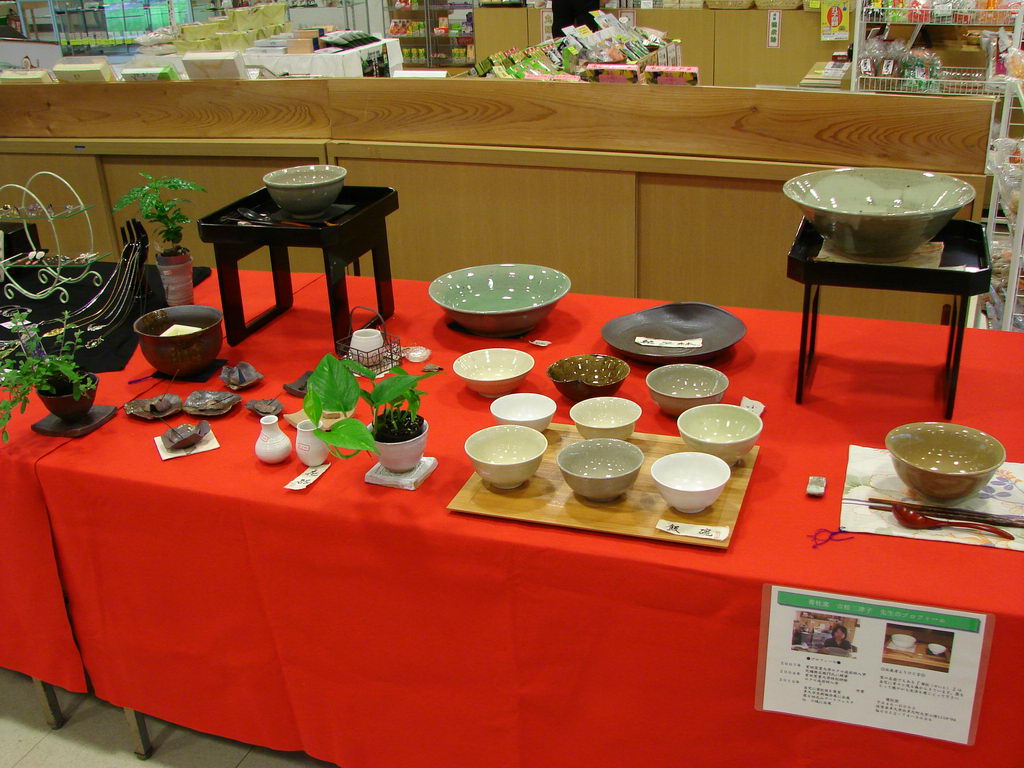
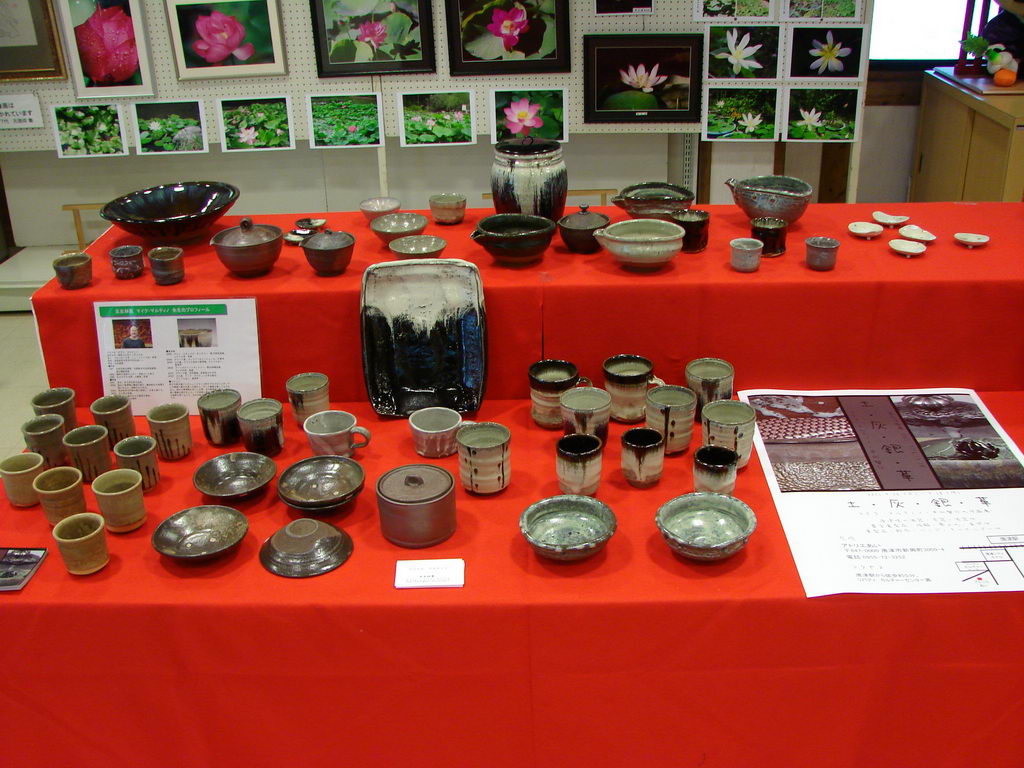
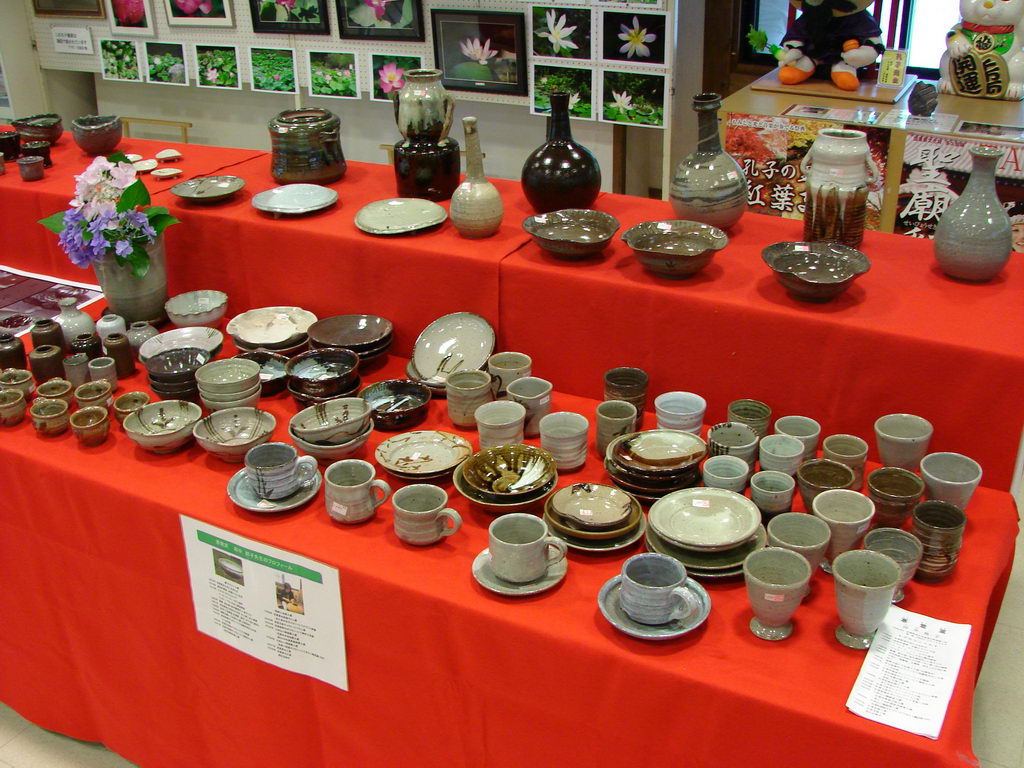
This last weekend we had the show in Karatsu. It was a 3 day weekend, so we did Sat, Sun, Mon. Well, if you are thinking about having a show on a 3 day weekend, let me give you a little advice: don’t. Everyone goes somewhere else. The first two days were absolutely empty, and it was only the during the last day that I was able to make some good sales. Thanks to guests from Osaka, Kyoto, and Chiba. I guess they were using the 3 day weekend to get out of their respective areas as well.
Well, lesson learned. Overall, it was still a very enjoyable experience, with lots of time to sit and chat with friends over tea. The highlight of the show was without a doubt, the shiboridashi teapot with the river crab knob. It is a pure silver crab holding a ruby in his right claw.
Chosen Karatsu Hoso Mizusashi (water jar) w/ lacquer lid. This guy sold.
Sometimes it is nice to change the pace a little, and kick the dust off of the woodworking tools. Usually, this involves making lids for pots.
Some of the nice lacquerware lids you see out there can be quite expensive, especially the ones that are custom made to fit a piece. In my price strata, that usually results in my work doubling in price, because the lid costs so much in relation to the price of the pot. This makes it tough to sell them. For a big name potter, that same lid may be only 1/20th the price of the pot, so it doesn’t influence the selling price all that much.
As a way around the lacquer lids, I started doing things in natural wood on my lathe at home. As a sub for ivory tea caddy lids, I use small pieces of exotic hardwood, or sometimes tagua nut, which is an ethical ivory substitute.
Here are some simple lids I made for the upcoming show. They are fairly ‘quick and simple’, in that I don’t want to spend more than an hour on any one of them, to keep my costs down. I want to have something that looks nice on the pot without contributing to the price. People looking at them can get an impression of how the finished/lidded pot looks, and they may like the lid, or replace it with a lacquer lid later on.
I am not a very good lathe worker, and still end up scraping most of that waste off, rather than a skilled lathe artist who would slice it off, thus avoiding a lot of sanding later. I do it this way because by scraping it is much less likely that there will be a catch, ruining the piece. After finishing the shaping and sanding, the cedar lids get burned and brushed, then oiled. Other hardware lids just get oiled after sanding.
Here they are (remember, clicking on a small image brings up the big image):
Chosengaratsu jar with Teak lid/Ebony knob. approx. 40cm tall
Emadaragaratsu water jar with burned cedar lid. H20cm
Chosengaratsu water jar with burned cedar lid. H20cm
Below are some pictures from the latest firing (of the gas kiln). There were a few nice pots in the firing, enough to fill in the gaps with the show next week. Lost most of the chawan and guinomi, but got a couple of each that I like.
Chosen Garatsu (the runny white over brown) constantly reminds me that I need more practice. Just when I think I’ve got it down, it shows me just how much I don’t know.
Abalone shaped bowl with feet
interior detail
Teabowl/Chawan, Chosengaratsu glaze, pinched from a ball on the kickwheel
rear view
bottom detail, firing on shells gives the red flashing on the foot.
Chosengaratsu teabowl/Chawan. Also pinched from a ball. This one came out the best in terms of glaze. I think I paid more attention because I was worried about the lack of vertical surface for the glaze to move on.
Madaragaratsu guinomi (small cup) with ame glaze accents. Pinched from a ball on the kickwheel.
Chosengaratsu guinomi
Yunomi/tea cup with ame glaze exterior and madara glaze interior.
Madaragaratsu yunomi/tea cup
Chosengaratsu yunomi. These as a group came out the best. None to hammer. Good runs, no warping.
Sounds kinda dirty, somehow, or maybe that’s just me. Anyway, when you fire Oribe greens, you usually get an oxide layer over the surface that dulls the color, or in extreme cases changes the color completely to a sort of what I always imagined the color of the Great Grey Green Greasy Limpopo River to be. (always loved Rudyard Kipling)
The traditional method for cleaning this up is chestnut husks soaked in water, which creates an acidic, extremely smelly brown concoction that you soak your dishes in for a few days. Nowadays, people use a 3% solution of hydrochloric acid. Now, this is nasty stuff so if you are going to use it, use it in a very well ventilated area, with gloves, eye protection, etc… When you open the bottle, white mist rises, just like in the movies. Breathing that is not a good idea.
Here is a before after pic of a dish I cleaned up. These dishes did not have a heavy oxide layer, but the cleaned one is noticeably brighter.
It has been raining cats and dogs since this morning, and we must have gotten about 8 inches in as many hours. Unreal. It is the first time the water has risen in my kiln to a level that would affect pots if they were loaded into the first chamber. In the past it has always stopped short of the front floor but today it was a couple of inches deep in the front floor area.
At least I had good weather yesterday and into early this morning for firing the gas kiln. Turned off the kiln at around 5 am (fired for 18 hours) and when I woke up at 6, it was pouring. Later in the day, I peeked into the kiln when it was still around 700C. Snapped a couple of pictures, with and w/o the flash. The first glance doesn’t look too good. Ame yu was a bit too thin, I think, but won’t know for sure until I open the kiln up completely and have a good look. One thing I am happy about is that the new clay blend I was testing seems to have stayed together nicely, no bad slumping (a little slumping, I like).
The go-nin ten is a tiny 5 person show that is more of an afterthought to the annual lotus blossom viewing event that happens here in Taku. Strictly speaking, it is not much of a chance to sell pots, but it is nice to mingle with the locals and meet new people. Most people come through the area after seeing the blossoms, give the pots a sort of disinterested glance and pass right out again. The ones that do stay to look however, are a good chance at advertising my bigger show later this month. I keep a stack of mailer postcards for people to take.
There are three other potters, and one jewelery maker exhibiting.
As we were settling in for the morning, getting ready for customers to come by, a HUGE box arrived by express carrier. This box was big, probably about 2x2x2 meters! Turned out to be the new town mascot costume. Since the town’s biggest attraction is the 300+ year old Confucian Temple, the Taku town mascot was voted to be Takuo, a big dude that looks like Confucius, a big Confucius who likes to run around and hug people a lot, and who has a fuzzy pink heart on his butt for people to rub.
Takuo being guided so he doesn’t knock down any munchies or souveniers.